
Every six months or once a year, banks introduce a new Repo Rate. But what exactly are the Repo Rate and the Reverse Repo Rate? What is the difference between the two, and why are they important for us? How can they even affect your loan EMI? In this blog, we’ll explore all of these questions in detail. We’ll take a deep dive into what the Repo Rate and Reverse Repo Rate are, how they differ from each other, and why they matter. However, our primary focus will be on understanding the Reverse Repo Rate in depth.
What is the Reverse repo rate?
The Reverse Repo Rate is the interest rate that the Reserve Bank of India (RBI) pays to commercial banks when they deposit their surplus funds with the RBI. Let’s understand this in a simpler way.When commercial banks have excess funds that are lying idle and are not earning any interest, they deposit these surplus funds with the RBI. In return, the RBI pays the banks interest on the amount deposited. This interest rate paid by the RBI is known as the Reverse Repo Rate.
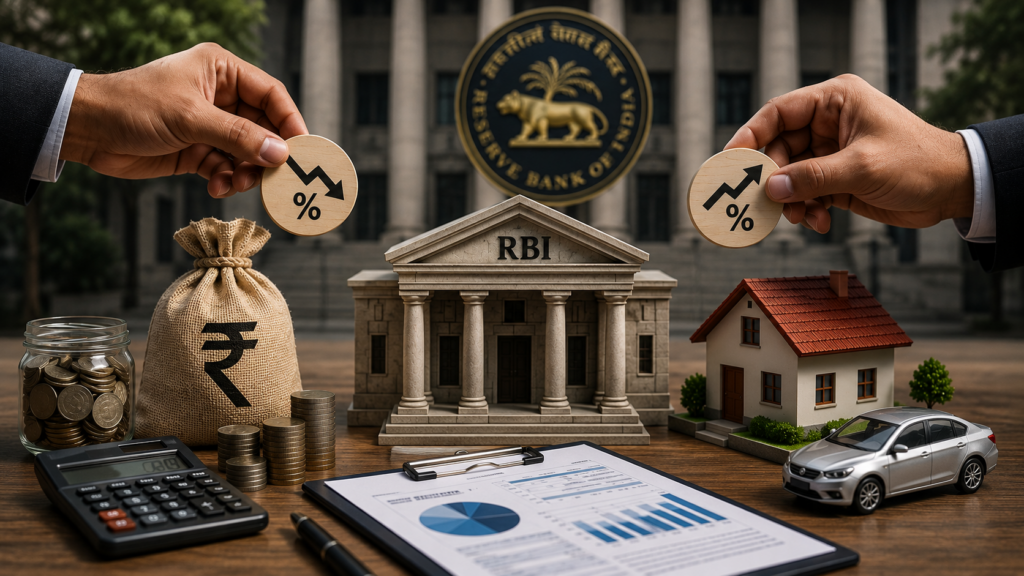
Consider it as the opposite of the repo rate, which is more frequently discussed. When commercial banks don’t have enough money, they borrow from the RBI under the repo rate. When banks have extra money, they lend it to the RBI under the reverse repo rate. Reverse repo agreements are essentially short-term, collateral-backed transactions in which the RBI temporarily borrows government securities and cash flows in the opposite direction, with the agreement to be reversed on a prearranged date.
Repo rate vs. Reverse repo rate: what’s the difference?
People often ask what is the difference between Repo rate and reverse repo rate, Since both are announced together during every RBI Monetary policy committee ( MPC) meeting , here is the side by side comparison.
| Basic | Repo rate | Reverse repo rate |
| Purpose | Commercial banks borrow from RBI | RBI borrows from commercial banks |
| Typical level | Usually higher | Usually lower than repo rate. |
| Effect on money supply | Increase money supply when cut | Reduced money supply when hiked. |
| Impact on your Loan EMI | Direct: most floating loans are linked to it. | Indirect: works through overall liquidity. |
To put it briefly, the reverse repo rate is what banks receive for lending their surplus to the RBI, while the repo rate is what banks pay to borrow from the RBI. The central bank employs both of these methods to control liquidity and maintain a healthy range for lending rates and inflation.
RBI repo rate Today: current rate in India
| Policy rate | Current rate (as of 2026) |
| Repo rate | 5.25% |
| Reverse repo rate | 3.35% |
| Standing deposit facility (SDF) Rate | 5.00% |
| Marginal standing facility (MSF) Rate | 5.50% |
One crucial detail to be aware of is that, since April 2022, the RBI’s primary instrument for absorbing excess liquidity from banks has been the Standing Deposit Facility (SDF), not the reverse repo rate. The SDF now handles the majority of the day-to-day liquidity management, although the reverse repo rate is still in place and is reviewed at each MPC meeting. For this reason, throughout the past few years, the repo rate has fluctuated with rate reduction, while the reverse repo rate has remained constant.
How Reverse repo rate works: A simple example
After fulfilling all of its lending and reserve obligations for the day, let’s say a commercial bank has ₹50 crore in excess funds sitting idle. The bank uses a reverse repo arrangement to deposit this idle cash with the RBI overnight rather than keeping it. The RBI returns the ₹50 crore and interest computed at the reverse repo rate the next day. In the event that the reverse repo rate is 3.35%, the bank receives a modest but assured return on funds that would not have generated any income otherwise. You can understand why the reverse repo rate, which is the RBI’s daily method of removing excess cash from the system, matters by multiplying this over the whole banking system.
Why RBI uses the Reverse repo rate: Liquidity management and inflation control
One of the RBI’s monetary policy instruments for managing liquidity is the reverse repo rate. An excessive amount of money in circulation within the financial system can lead to excessive lending, overheated demand, and increased inflation. The RBI encourages banks to store excess money with the central bank rather than lending it out aggressively by providing an alluring reverse repo rate. This helps reduce inflation by removing money from active circulation. On the other hand, the reverse repo rate can be made less appealing if the RBI wants to encourage banks to lend more and stimulate the economy. This would encourage banks to put their money into loans rather than holding it with the RBI. The main way that RBI monetary policy influences the larger credit market is through this push-and-pull between repo and reverse repo rates.The main way that RBI monetary policy influences the larger credit market is through this push-and-pull between repo and reverse repo rates.
How does Reverse repo rate affect personal loans and other loans
For you as a borrower, this is where things get crucial. Through the total liquidity in the banking system, there is an indirect relationship between the reverse repo rate and personal loan interest rates:
- Effect on individual loans: Banks have more capital available to lend and are less likely to park money with the RBI when the reverse repo rate is low and unappealing. This may facilitate easier loan approvals and more affordable personal loan interest rates.
- Impact on home loan: Most floating-rate home loans are linked to the repo rate through external benchmarks (EBLR), so home loan EMIs respond more directly to repo rate changes. However, overall liquidity conditions shaped by the reverse repo rate and SDF still influence how quickly and how much banks pass on rate changes.
- Impact on business loan: for MSMEs and business owners, higher systematic liquidity generally means banks are willing to extend working capital and business loans at reasonable rate, since they have more funds to deploy rather than park with the RBI.
- Impact on EMI: A cut in the reverse repo rate tends to support softer lending rates over time, while a hike can tighten liquidity and push borrowing costs up gradually
Since the majority of retail loans are specifically benchmarked to the repo rate, the repo rate actually affects your loan interest rate more quickly and directly than the reverse repo rate. However, the liquidity backdrop that affects banks’ initial comfort level with lending is shaped by the reverse repo rate (and now the SDF).
Reverse repo rate and inflation
One of the RBI’s primary responsibilities is to control inflation, and one of its tools in this regard is the reverse repo rate. A higher reverse repo rate (also known as the SDF rate) helps lower inflationary pressure by absorbing surplus money from the banking system and reducing the quantity of money chasing goods and services. Instead of drastically reducing liquidity, the central bank has more leeway to maintain rates that support growth while inflation is well within the RBI’s target range, which has often been the case through 2026.
Best time to apply for a personal loan based on RBI rate trends
You can better time your application if you intend to borrow money by keeping an eye on the RBI’s monetary policy calendar. Borrowers typically benefit from times when the RBI has lowered or maintained the repo rate after a string of reductions, as has been the case until 2026, because banks are typically more competitive on interest rates for house and personal loans during these periods. Since different banks and NBFCs translate RBI rate changes into different loan offers, it’s also important to compare lenders directly.
FAQs
1. How does Reverse repo rate affects personal loan
It has an indirect impact on personal lending. Banks are encouraged to lend rather than hold money with the RBI when the reverse repo rate is lower, which can lead to more affordable personal loan rates and simpler credit availability.
2. What happen when the reverse repo rate increase or decrease?
An rise tightens liquidity and aids with inflation control by making it more appealing for banks to lodge money with the RBI. A reduction encourages banks to lend more and promote growth by discouraging parking cash with the RBI.
3. What is the current reverse repo rate in India?
The reverse repo rate is 3.35% and the repo rate is 5.25% in accordance with the RBI’s 2026 monetary policy. The Standing Deposit Facility, which is now at 5.00%, has been the RBI’s main source of daily liquidity absorption since 2022
4. What is Reverse repo rate?
The interest rate that the RBI offers commercial banks for temporarily depositing their excess funds with it is known as the reverse repo rate. The RBI utilizes it as a tool to take excess money out of the banking sector.