
For the past few weeks, we have been talking about finance-related topics because that is our domain. But in today’s blog, we are going to discuss a very interesting topic. The main motive behind our blog writing is to make finance and certain banking-related terms, which are actually a bit complicated, feel easy for you so that you can relate them to your day-to-day life. Today’s blog is also somewhat similar, but a little different from typical finance topics. This time, we’ve added a little “tadka” while trying to explain things to you, and trust us, you’re going to enjoy this tadka even more than dal! So, let’s get started
Picture this.
It’s Sunday evening; you and your four friends land at your favorite dhaba. This is that very dhaba whose dal makhni is its biggest specialty, and people come from far and wide just to eat there. And those plastic chairs kept outside feel as if they are calling you themselves, “Come, have a seat.”
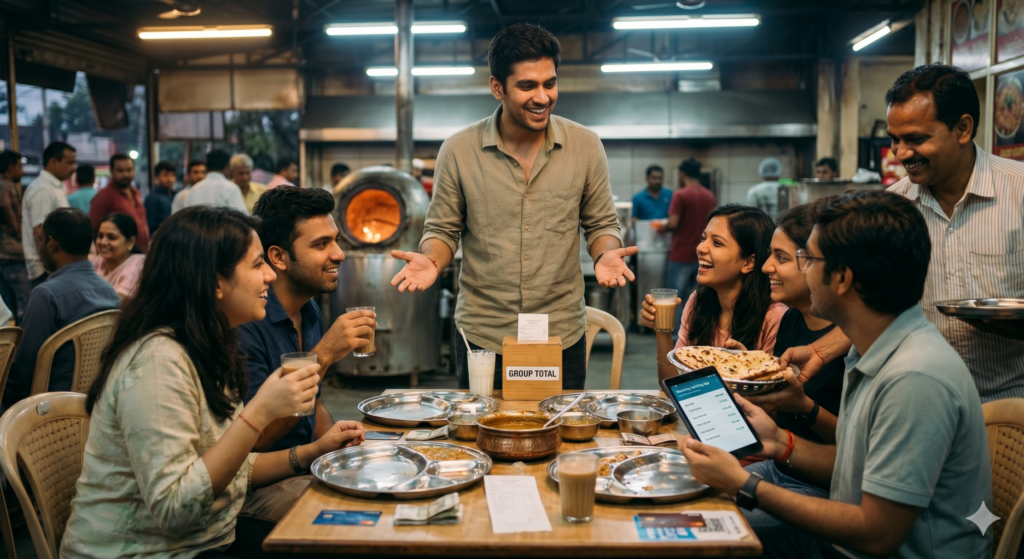
The waiter arrives. Everyone looks at each other. silence
Finally, someone says, “Bhai, tu hi order kar,” and that someone is always you. But here’s what’s actually interesting: this isn’t about your friends being lazy or inconsiderate. There’s a very logical, very human reason behind why this keeps happening. And economists have been studying this exact behavior for decades.
Let’s get into this.
The Anchoring Trap:
When someone orders first at a dhaba, they accidentally set the tone for the entire table.
Place an inexpensive order? Everyone now feels uncomfortable purchasing the pricey items. or place an expensive order? Everyone has been forced to order up to match you or feel bad if they don’t. This is called the anchoring effect. The first number (or in this case, the first order) becomes the reference point for every decision that follows. Therefore, no one desires that duty. The outcome? For five minutes, everyone at the table looks at the menu until the most determined (or hungry) person gives in. Usually, you are that person.
So basically this anchoring effect was given by famous psychologists Daniel Kahneman and Amos Tversky. It was basically the idea in which humans rely too heavily on the first piece of information they receive when making decisions. The first number is the anchor, and your brain uses it as a measuring stick for every decision after that. This is why salespeople always show you the expensive product first, and Amazon shows you the “original price” crossed out before the sale price.
The free rider problem
Here’s where it gets interesting
This is the classic concept from game theory and public economics. The moment when someone says, “Let’s split equally,” then suddenly something shifts in everyone’s brains. Suddenly that extra butter naan looks reasonable. The chicken afghani doesn’t seem that expensive anymore. One more lassi? Why not?
Because when the cost is shared, individual accountability disappears. Economists call it the “free rider problem” when people benefit from the shared resources without bearing the full cost; they naturally consume more than they would if they were paying alone.
The Bystander effect
This one plays out in groups more than anywhere else
When people’s responsibility is shared across multiple people, each person assumes someone else will handle it. This looks like
- Nobody cleans the dishes because someone else will clean.
- Nobody question the bill price because someone else will
This idea originated in social psychology and was initially investigated following a real-life incident in 1964 in New York where a woman was attacked in public and no one intervened because they thought someone else would.
The Mental accounting glitch
Ask any of your friends how much they’ve ordered, and they will underestimate every single time, and this is because of something called mental accounting. Small, incremental expenditures are not accurately tracked by our brains. That additional papad? forgotten. The second chai round? doesn’t apply. The raita dip that inexplicably filled the bowl? Invisible
However, everyone honestly thinks they placed a smaller order than they actually did when the bill shows up. The person who ordered more doesn’t even remember placing the order, so the “split equally” suggestion seems unfair to the person who had less. No one is lying. Their minds actually went blank. However, the math doesn’t care.
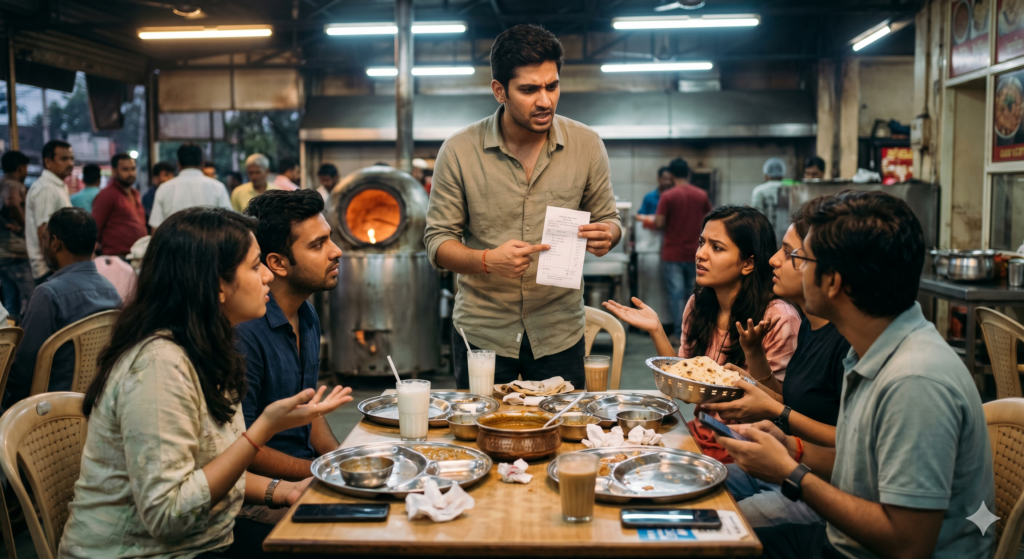
So what’s to fix?
The good news is that you don’t have to change your friends; it just require to changing the system
- “Everyone will go dutch” means that each person will pay for their own share of the expense, simple, clean and no awkwardness
- Use a split app that keeps track of who placed what orders in real time
- Set a rough per-person budget before ordering. “Today’s budget is only 300,” and it will work surprisingly well.
Change the name and the behaviour changes automatically
The bigger point: Why it matters beyond the Dhaba
The dhaba bill is insignificant. However, the underlying patterns, avoiding tough financial conversations, failing to monitor spending in real time, and allowing social comfort to take priority over financial clarity, also appear in much larger decisions.
It is like when people avoid discussing loan terms because it feels “formal.” Or when families avoid discussing financial planning because they believe “everything will become fine. ” Or when someone takes on debt without fully understanding the repayment structure.
We at Bikesh Finserv think that having financial clarity shouldn’t be difficult. You deserve accurate and transparent information, whether you’re comparing lenders or comprehending your loan options.
Because poor financial decisions always end up costing more than they should.