
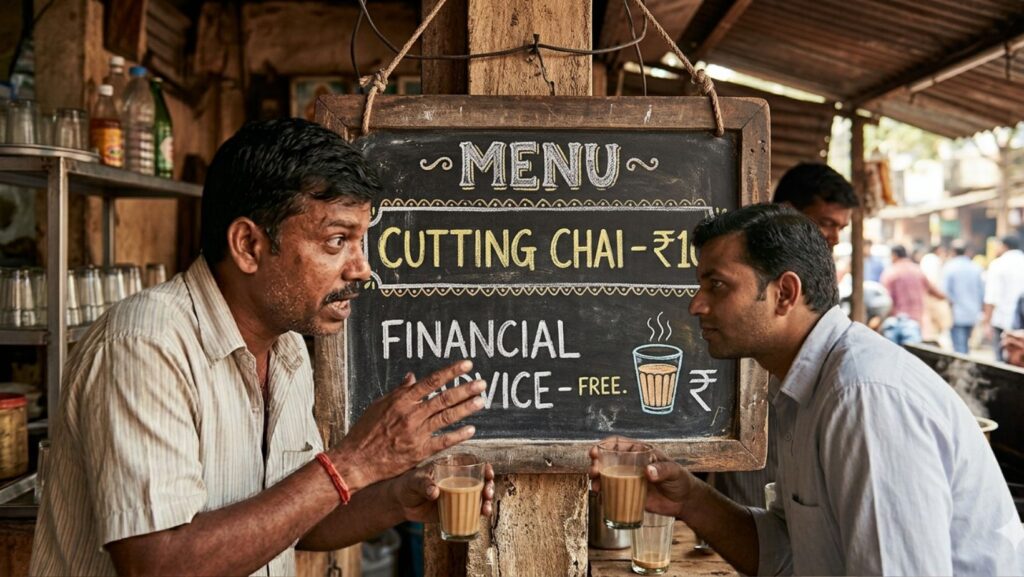
Pull up a stool at any chai tapri in India, and within 5 minutes, someone in the group will offer you free financial advice. It might be about which stock is a sure shot, why you should never take a loan, and why putting your entire savings into LIC is the best decision ever that you’ll ever make. These Indian financial myths have been repeated for so long that they start to feel like facts rather than opinions.
The truth is, most of this bad money advice doesn’t come from bad intentions. It’s bad financial advice passed down by people who genuinely want to help, like parents, relatives, or friends, based on what worked for them. Without accounting for how much personal finance in India has changed. Digital lending, SIPs, credit scores, and modern insurance products have reshaped Indian money habits in ways that older advice simply doesn’t account for.
So before you nod along to the next round of money myths in India over your evening or morning chai, let’s break down five of the most common ones and what the reality actually looks like.
Let’s walk through every myth of financial habits by our OG uncles.
“LIC Is the Only Investment That Matters”
This one usually comes from someone whose entire financial plan is a collection of LIC policies bought over the years, “isme paisa double ho jata hai, aur life cover bhi milta hai.” It sounds like the best of both worlds: insurance and investment in one product.
In reality, mixing insurance and investment often means getting a less extreme version of both. Traditional legacy or whole-life policies tend to offer modest returns, often in the range of 4–6% per year, while requiring high premiums for the cover they provide.
A more effective approach, used by most financial planners, is to separate the two goals. A term insurance plan offers a much larger life cover for a fraction of the premium, making sure your family is financially protected. The money saved on premiums can then go into SIPs, PPF, or other instruments built specifically for growing wealth. LIC isn’t “bad.” but treating it as your only investment is one of the most common Indian money myths, simply because it confuses two very different financial needs.
“EMI Is a Trap”
EMIs get a bad reputation at every chai tapri, usually right after someone’s son or cousin “fell into the trap” of paying for a phone in installments. But an EMI itself is neither good nor bad; it’s simply a way to pay for something over time instead of all at once.
The actual question is what you’re purchasing and whether it fits your budget or not. An EMI for a laptop you need for work, or a bike that you purchased to get to your job every day, is very different from stacking multiple EMIs for things you don’t really need, just because “EMI itni kam hai; easily ho jayega.”
The actual trap isn’t the EMI; it’s losing track of how many EMIs you’re dealing with at once. When monthly EMI payments start eating up a large percentage of your income, that’s when financial stress builds up. If you ever find yourself there, options like debt consolidation loans exist specifically for you to combine multiple high-interest EMIs into a single, more manageable monthly payment, rather than avoiding EMIs altogether out of fear.
Never Take a Loan
If there’s one piece of bad financial advice from relatives that gets repeated the most, it’s this: never borrow money, no matter what. This made sense to a generation that had little access to official credit because loans were frequently linked to moneylenders, high interest rates, and financial strain.
But today’s lending landscape looks very different. A home loan provides tax advantages while assisting you in purchasing an asset that typically appreciates in value over time. A degree that greatly boosts your earning potential can be financed by an education loan. When taken out for a specific purpose and paid back on time, even a personal loan can help you manage a financial need without interfering with your savings.
The distinction between good and bad debt, that is, debt that helps you develop a skill or asset versus debt that finances temporary desires with no long-term value is what really counts. Avoiding all loans can work against you rather than protect you. When you apply for larger loans in the future, lenders closely examine your credit history, which is why it’s crucial to comprehend the significance of a credit score in India. It may be more difficult to get approved for a home loan when you truly need one if you have a thin or nonexistent credit history as a result of “never borrowing anything.”
“A Government Job Is the Only Safe Career”
This is a classic chai tapri, especially if you have an uncle nearby who has worked for the government for thirty years. The reasoning is that working for the government entails no risk, a pension, and a guaranteed salary. What more could you possibly require? The security section is true. However, “safe” and “wealth-building” are not synonymous. Many people who only work for the government wind up relying solely on that source of income for decades because government salaries frequently increase slowly.
Private sector positions, on the other hand, frequently offer faster pay growth, performance bonuses, and greater flexibility to generate extra income through investments, side projects, or skills, even though they may seem less secure on paper. Your paycheck is not the source of true financial security. Whether you work for the government or not, it depends on how well you manage, save, and grow whatever money you make.
“Property Always Doubles in a Few Years”
Property nearly always comes up first when you ask someone at a chai tapri about investing. It’s practically gospel: “Zameen lo, kabhi loss nahi hota. “To be fair, in rapidly expanding cities, many people did witness notable appreciation on real estate purchased decades ago.
However, real estate isn’t the guaranteed-double machine that people think it is. Property comes with expenses that don’t show up in casual chai-time math, such as registration fees, maintenance, property tax, and money that is locked up and difficult to access quickly if you need it. Returns vary greatly depending on location, timing, and demand.
Compare that to a SIP investment in India; a systematic investment plan in mutual funds lets you start small, stay spread out across companies and sectors, and access your money when needed. Over a long horizon of 15–20 years, SIPs in equity mutual funds have historically delivered returns comparable to, or better than, many real estate investments, minus the maintenance headaches. This doesn’t mean real estate is a bad investment; it just shouldn’t be the only one in your portfolio, no matter how confidently your tapri-mate insists otherwise.
“The Real Takeaway From Your Next Chai Break”
This does not imply that the people giving this advice at your neighborhood tapri are indifferent or that their experiences are unimportant. In the economic climate of a previous generation, when formal credit was more difficult to obtain, investment options were scarce, and government jobs actually provided more stability than they occasionally do now, many of these beliefs made sense.
However, Indian money habits have changed along with personal finance. Investment options are more varied, credit is easier to obtain, and information that used to take years to learn is now just a search away. The most common financial error made by Indians is not taking chances, but rather sticking to out-of-date financial advice without making sure it still holds true.
So the next time someone hands you a piece of financial wisdom along with your cutting chai, feel free to nod, smile, and say, “Thanks!” and then go do a little research of your own before deciding what’s right for your money